
















You can definitely swim in open water almost all year round - you just need to keep three things in mind: the water temperature, the right equipment and your safety. If you jump in without them, even a summer dip can quickly become a chilly experience. At Watery, we've gathered everything here so you can swim safely, whether it's a mild August morning or icy January waters.
Start with the most important number: the water temperature. It determines how thick your neoprene should be, what else you should wear, and how long you can stay in. Use this table as your quick reference:
If you want to see today's water temperature right now, you can find it in our live water temperature overview - We update it daily, so you know exactly what awaits you before you dive in. 🌊
When is the water warm enough to swim?
It's a bit of a matter of opinion and experience, but there are some general guidelines you can follow.
Below 5 degrees
When the water is below 5 degrees, it's simply too cold. Even with a wetsuit, you can't handle it, and it will become an extremely unpleasant experience if you try. The cold water hurts against the body, and you simply can't keep warm enough to swim properly.
It's exclusively for experienced cold-water swimmers, and even they stick to a few minutes at a time. Never dive in headfirst, walk in calmly, and stay close to shore.
6-10 degrees
It's still very cold, and it will be uncomfortable for the skin not covered by the wetsuit. However, you can swim in it as long as you take the right precautions. With the right precautions - calm breathing, short duration, and a swimming buddy - you can typically stay in the water for about 30-45 minutes, but often much less if you get cold quickly.
A wetsuit makes a huge difference here and significantly extends the time you can keep going.
If you plan to swim regularly in this temperature, a good neoprene wetsuit is worth its weight in gold. See our selection of wetsuits here.
11-15 degrees
The water is starting to approach temperatures suitable for swimming. It can still be painful for hands and face at first, and you shouldn't spend several hours in the water. However, you can manage about an hour or a little more.
As long as you prepare well and bring neoprene socks and cap along with your suit, you can definitely have a good experience in the water. It will still feel cold, but it's not as uncomfortable as at lower temperatures.
16-19 degrees
Now it's no longer a big problem to jump into the sea and swim away. The body still needs to get used to it, but once you get going, you can keep going for several hours if the sun is out.
The water is now more refreshing than downright cold, as long as you have your wetsuit on. However, it can still take some time to regain warmth when you get out of the water. If you're prone to feeling cold, it's a good idea to use neoprene socks or swim shoes.
20 degrees and above
Here, as mentioned, it's unnecessary for most to use a wetsuit. You should, of course, do what suits you best, so if you tend to feel cold, you can start by putting it on and then take it off when it gets too warm.

How long can you stay in cold water?
The colder the water, the shorter the time you can stay in it. That's the main rule, and it holds true all the way down the scale. But there's no single number that fits everyone, as how long YOU can stay in depends on your fitness, your experience with cold water, how much insulating fat you have, and whether you're swimming in a wetsuit or just swimwear. Two people in the same water can have very different limits.
If you're a beginner, start short and build up over time. A few minutes at a time is plenty at first, and your body gradually gets used to the cold over weeks and months. Don't push it, and don't compete with those who've been doing it for years. Specific time frames for each temperature zone can be found in the section above and in the hero table at the top.
Temperature and clothing in the water
You choose your wetsuit based on the water temperature - it's the thickness of the neoprene (measured in mm) that determines how warm it keeps you. The colder the water, the thicker the neoprene. Below are our guidelines zone by zone, so you get it right from the start.
Over 20 degrees
In really warm water, you rarely need a thick suit. Here you can manage with a regular swimsuit / swimwear or a thin 2 mm shorty wetsuit, which mostly protects against sun, wind, and scratches. It's about comfort, not warmth.
16-20 degrees
The classic summer and spring suit. A 3/2 mm wetsuit means 3 mm over the body and 2 mm at the arms and legs, so you stay warm without losing mobility. It fits perfectly for most swimming seasons.
11-15 degrees
When the water drops to the lower end of double digits, you need to increase the wetsuit thickness. A 4/3 mm wetsuit provides significantly more insulation and is a good choice for early spring and late autumn when the water still bites.
6-10 degrees
Here it gets seriously cold. A 5/4 mm wetsuit is the minimum, and we recommend supplementing with a cap, gloves, and socks so you don't lose heat through your head, hands, and feet. These are the areas where heat escapes first.
Under 5 degrees
In winter-cold water, you're in the extreme zone. Here you need a 6 mm full winter wetsuit - or a drysuit if you want to stay completely dry underneath. At this level, the gear isn't just for show: it's what keeps you safe.
We do not recommend swimming in these temperatures unless you are 100% confident in it + never swim without a support boat.
Fit and quality matter as much as mm
A wetsuit only works if it fits snugly. The neoprene should fit the body without being tight, so cold water doesn't constantly flow in and out - it's the thin water film that your body heats up that insulates you. If the suit is too loose, you lose warmth; if it's too tight, you can barely breathe.
Pay attention to arms and legs: if you want full coverage and maximum warmth, choose long arms and legs, while a shorty with short legs gives more freedom in warm water.
And a good tip: stay away from the cheapest dubious suits. Poor neoprene insulates worse, wears out quickly, and lets cold water in - and in cold water, it's not just comfort, it's safety and warmth at stake.
How we choose thickness at Watery
At Watery, we always start with one question: how cold is the water, and how long will you be in it? From there, we match thickness, fit, and type so you neither freeze nor pay for more suit than you need. If you're in doubt, write to us - we're happy to help you find the right one.


GET A DISCOUNT CODE WITH 10% OFF
The discount code can be used by all new customers on all products on the website, including the products recommended here in the article.
What are you waiting for? Get more out of your time in and on the water!
What other equipment do you need?
As we mentioned in the last section, here's the extra gear. When the water gets cold, it's especially the head, hands, and feet that lose heat quickly - so that's where you need to focus. The wetsuit covers the body, but the extremities need their own protection.
Neoprene cap is the most important accessory in cold water, as you lose a lot of heat through your head. It also retains heat if you submerge your head. Neoprene gloves save your fingers, which otherwise become stiff and numb in just a few minutes. And neoprene socks do the same for your feet, which are the first place you really start to freeze.
A thin rashguard layer also makes it easier to get the suit on and off and can be advantageously used.
And then there are goggles - you need them regardless of temperature. They protect your eyes from salt and chlorine and give you clear vision so you can keep your direction and see where you're swimming.
What is hypothermia and how do you avoid it?
Hypothermia is when your body temperature drops below 35 degrees. It's dangerous and potentially life-threatening, and the sneaky thing is that it often develops slowly and insidiously while you're in the water. You don't necessarily register how far the cooling has progressed until it's serious.
As we mentioned earlier, the body starts sending clear signals when it's getting too cold.
Hypothermia affects the body as follows:
- Metabolism decreases
- You consume less oxygen and produce less carbon dioxide
- You stop shivering, even though you're still very cold
- The heart works less and less
- The pulse drops
- Blood circulates more slowly, increasing the risk of blood clots
- Eventually, you stop breathing
If you experience even one of these symptoms, get out of the water immediately. Then warm the body gradually with dry clothes and shelter.
You should not rub the skin vigorously, and you should not warm the body with sudden, intense heat - both can strain the circulatory system. Never use alcohol to warm up; it feels warm but actually cools the body further.
Our best advice to avoid cooling down
- Don't stay in the water too long. Stick to the durations we discussed above, and get out before you get too cold.
- Dress appropriately. A wetsuit and the right accessories - as described above - make a big difference in how long the body can retain heat.
- Never swim alone in cold water. With a buddy, there's always someone to spot the symptoms and help you out in time.
The last point - never alone - leads us to the broader safety measures you should have in place before you go into the water.
How to protect yourself from accidents in open water
The most important rule is simple: never swim alone. With a buddy, you can keep an eye on each other, spot problems in time, and help if something goes wrong. If one of you gets a cramp, becomes disoriented, or loses orientation, there's always someone to intervene.
Equally important: know your limits. Listen to your body, and don't take "just one more stroke" when your arms get heavy or you feel cold. It's better to turn back too early than too late, especially when you're far from shore.
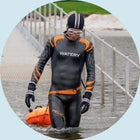
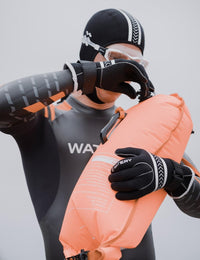
And remember to be visible in the water, so both boats and other swimmers can see you. A swim buoy lights up on the surface and makes your position clear.
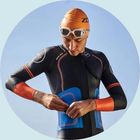
A dry bag is a great alternative if you want to pack keys, phone, and dry clothes and take them with you on your swim.
And the very basics: check the conditions before you go in. Watch the wind, current, and weather, and skip the trip if it looks unsafe.


