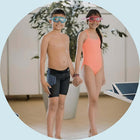
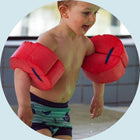
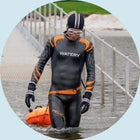
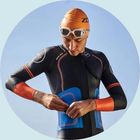
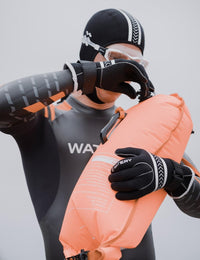
Does your boy need a wetsuit for playing in the pool, a trip on a SUP board, or both? Here you’ll find a wide selection of wetsuits for boys - from shorty models that are perfect for warm summer days at the beach to wetsuits designed for paddleboarding, kayaking and surfing, where a little extra freedom of movement in the arms and shoulders is essential.
Below, we guide you through how to choose the right type, thickness and size, so you can both feel confident in your choice - whether you choose a model from Watery, Konfidence or one of our other brands.
How to choose the right wetsuit for your boy
The first and most important choice is not the thickness or size - it is what your boy will actually be using the wetsuit for. A wetsuit that is perfect for an afternoon in the pool is not necessarily the best companion on a SUP board, and vice versa.
Shorty wetsuit for the pool and beach
If your boy will be using the wetsuit for swimming at the pool, playing in the waves or spending a day at the beach, a short shorty wetsuit with short sleeves and legs is usually the best choice. It is easy to put on and take off - something any parent who has wrestled a clammy wetsuit onto an impatient seven-year-old can appreciate - and provides plenty of freedom of movement in the arms and legs without your boy overheating in the summer heat. Explore our selection in the Calypso Shorty range, which covers most of these needs.
Paddleboarding and SUP wetsuit for more active time in the water
If, on the other hand, your boy will be standing on a SUP board, paddling a kayak or trying his hand at surfing, he needs a wetsuit designed for movement. A paddleboarding wetsuit offers extra flexibility in the shoulders and arms, so paddling and balancing are not restricted by tight neoprene. You’ll find the full selection under wetsuits for paddleboarding, SUP and surfing.
Full-body or long-sleeved wetsuit for colder water and longer days
If your boy will be in the water early in the season, or typically stays in the water for several hours at a time, a long-sleeved or full-body wetsuit may be a better choice than a shorty - whether he is heading to the pool, beach or paddleboard. It covers more skin and retains heat when the wind picks up or the water is not yet warm enough for summer.
Neoprene thickness and warmth - choose according to the season and water temperature
Once you have chosen the type, the next question is how much neoprene your boy needs. The thickness determines how much heat the wetsuit retains - and how freely he can move his arms and legs.
Most children’s wetsuits in our selection are around 3 mm neoprene, and that is no coincidence. This thickness offers a good balance: enough insulation for a typical Danish summer day in the water, without making your boy feel stiff when he needs to swim, paddle or build sandcastles.
If he will be in the water in early spring or late autumn, when the water is still cold, a thicker wetsuit may be worth the investment - it retains heat more effectively, but also makes the wetsuit slightly stiffer to move around in. Conversely, a thinner wetsuit can be ideal on very warm summer days, when the main priorities are UV protection and a little extra buoyancy rather than keeping the cold out.
The rule of thumb is simple: the colder the water, the thicker the neoprene - and the more important it becomes that the wetsuit fits snugly, so the cold layer of water does not seep through.
How to find the right size and fit
Once you have found the right type and thickness, there is only one practical question left: does it fit your boy’s body properly? And that is far from insignificant - a wetsuit only works optimally when the fit is just right.
The wetsuit should fit closely against the body without feeling tight. If it is too big, water can seep in around the neck, sleeves and legs, causing the insulation to lose its effect - your boy will feel cold even though he is wearing neoprene. If it is too tight, it will restrict the chest and shoulders, making it difficult to swim, paddle or even reach up for a ball. Therefore, always check that your boy can move his arms and legs freely while there is no excess space around the stomach, wrists or ankles.
If your boy is growing quickly - as most children do - it is worth knowing that some of our baby wetsuits are designed to grow with him. They can be adjusted in length and fit, allowing the wetsuit to last the entire season even if he has suddenly shot up in height. If your boy is outgrowing children’s sizes, you’ll find a larger selection in junior wetsuits, which are cut for older boys.
Why neoprene is ideal for active boys in the water
Why are almost all wetsuits made of neoprene - rather than simply a thick piece of swimwear? The answer lies in the material itself. Neoprene is filled with tiny, airtight cells that trap a thin layer of water between the skin and the wetsuit. This layer is quickly warmed by body heat and then acts as an insulating barrier that retains warmth - exactly what an active boy needs when he spends hours in the water rather than minutes.
As a welcome added benefit, neoprene also protects the skin from the sun’s rays. This is not the reason to choose a wetsuit instead of swim trunks, but it is a useful bonus on days when sunscreen has already been sweated off after an hour in the waves.
If you would like to learn more about how a wetsuit actually works, and why children generally need more protection from the cold than adults, you can read the full explanation on our comprehensive page about wetsuits for children.
Extra safety with a wetsuit
Neoprene keeps your boy warm and provides a certain amount of natural buoyancy - you will both notice this as soon as he stretches out in the water. But do not be misled by the floating sensation: a wetsuit is not a safety-approved flotation device and should never be used as a substitute for supervision or a proper swim vest or life jacket.
If your boy is learning to swim, or you are in a place where extra reassurance in the water is needed - a harbour, a beach with waves or simply an unfamiliar pool - it is a good idea to combine the wetsuit with a swim vest for children. This gives your boy both the warmth of the neoprene and buoyancy that has genuinely been tested and approved to keep him afloat.
How to keep your boy’s wetsuit looking great for many seasons
A wetsuit is an investment, and it will last for much more than one summer if it is treated properly after use. It does not take much - just a few simple habits:
Rinse with fresh water after every use: Chlorine from the pool and salt from the sea break down neoprene over time. A few minutes under the shower or tap after swimming will significantly extend the life of the wetsuit.
Avoid soap and washing machines: Soap and detergent damage the neoprene’s cells, while machine washing can cause tears in the material. Simply use clean water - that is enough.
Hang it to dry away from the sun: Place the wetsuit on a hanger in the shade so it does not become stiff or fade in direct sunlight. Then store it in a dry place, preferably flat or on a hanger.
Repair small tears immediately: If the neoprene develops a small hole or tear, you can repair it yourself with neoprene glue before the damage gets worse. Also take a look at our wetsuit accessories if you need to get the rest of your equipment sorted.
Buy your boy’s new wetsuit from Watery
Now you know what to look for in terms of type, thickness and fit - so all that remains is to find the one that suits your boy best. At Watery, you’ll find wetsuits from our own Watery brand as well as Konfidence, Aquasphere, Beco, SEAC, Arena, Cruz and Speedo, allowing you to choose across price, design and functionality without compromising on warmth or freedom of movement.
Do you have a girl in the family, or is your boy outgrowing children’s sizes? Then take a look at our selection of wetsuits for girls or junior wetsuits for older boys - both offering the same selection of shorty and paddleboarding models you already know from this range.
Find the right wetsuit for your boy today, so you’re ready the next time the sun - or the SUP board - calls.
 Equipment
Snorkel equipment
Open water swimming
Stand up paddle
Kids
Brands
Equipment
Snorkel equipment
Open water swimming
Stand up paddle
Kids
Brands







 Wild Water Days