








When you take your child to the swimming pool or the beach, you quickly experience the great joy that playing in the water brings. To ensure complete safety from the start, it's crucial that you familiarize your child with the water early on, and the ability to float is the very first big step on this journey. Through fun exercises, you can easily teach your child to relax on the surface, and with the right baby swimming equipment, such as a supportive swim belt or a safety-approved swim vest, you add extra help and security to the learning process. Here are our best tips on how you can safely guide your child towards a lifelong love of water with concrete techniques.
What equipment helps my child to float?
At Watery, we draw on many years of experience from the swimming pool and close dialogue with thousands of customers when selecting our equipment. We know exactly what it takes to create a safe experience in the water, and we have therefore handpicked these four favorites that give your child the right buoyancy and support to learn to float.
| Product Type | Recommended Product | How does it help the child? |
|---|---|---|
| Swim Belt | Watery swim belt for children (15-60 kg) | Provides a natural lift to the center of gravity and frees both arms and legs, allowing the child to practice the correct swimming strokes undisturbed. |
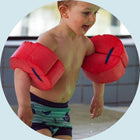
| Arm Bands | Malmsten arm bands | Keeps the upper body and head safely above the water surface. Made of puncture-proof foam, providing stable buoyancy. |
| Swim Vest | Watery swim vest for children (1-6 years) - Splashy | Wraps the upper body with even buoyancy and full freedom of movement. Removable foam elements make it easy to adjust the support as the child learns to float. |
| Combined Float Set | Beco float set (Belt & arm bands) | Combines belt and bands for maximum buoyancy and safety. The belt lifts the body horizontally while the bands provide calm around the upper body. |
How do I teach my child to float?
Learning to float is the foundation of all swimming and creates true safety in the water. Whether you're attending baby swimming classes or enjoying the local pool, this learning is best built on play and presence. Aids are fantastic for providing security, but they work best as a supplement to your joint exercises rather than a replacement. Here are three specific exercises that train your child's ability to rest calmly on the water surface.
- The Star on the Back: Let your child lie on their back while you gently support under the neck and lower back. Ask the child to stretch arms and legs wide like a star. Maintain eye contact and speak soothingly, so the body relaxes and begins to float naturally.
- The Motorboat on the Stomach: Hold your child securely under the arms in a horizontal position. Ask the child to make small, gentle kicks and blow bubbles on the water surface. The exercise quickly gets the child used to the sensation of buoyancy.
- Support with a Pool Noodle: As balance improves, you can advantageously use a pool noodle as a fun support tool in the exercises. Place it under the child's arms or shoulders to provide light buoyancy while gradually releasing your own support.
To make it even easier for your child to learn to float, we recommend supplementing the exercises in the water with a swim belt, a good swim vest, or a pair of arm bands. This provides the extra freedom and security often needed for the child to fully let go of control.
Why a swim belt provides the optimal support for swimming strokes
Even when you're participating in baby swimming or playing in the local pool, it's a good idea to start with simple exercises to teach your child to float. For example, you can let the child lie on their back while you lightly support under the neck and lower back, so you find balance in the water together. When the child begins to feel confident floating on their own, a swim belt serves as a fantastic addition to the child's learning. The belt provides a natural lift to the center of gravity, freeing both arms and legs, so your child can practice the correct swimming strokes undisturbed. From our many years of experience in the swimming pool, we know that the right support builds enormous confidence. Just remember to always choose a model based on the child's weight and not age, so the buoyancy fits precisely. To make the choice easier for you, we have selected our three favorites from our entire range of swim belts:
- Our own recommended Watery swim belt: Combines optimal comfort with adjustable buoyancy for the weight class 15-60 kg, so you can easily remove foam blocks as your child becomes a better swimmer.
- Beco Sealife swim belt: A well-known classic from the swimming pool for 15-30 kg, which sits comfortably with its soft foam blocks and a secure, child-friendly click buckle.
- Beco neoprene swim belt: An incredibly soft and comfortable alternative with a neoprene cover that protects the skin from chafing and provides stable buoyancy for the child's first independent swimming strokes.


Arm bands create security and keep the head above water
When teaching your child to float, it's primarily about safety. Through small exercises in the water, where you, for example, support the child's back and neck, you slowly build trust. Here, a swim belt or a pair of arm bands serve as fantastic extra help for learning. They allow the child to actively use their body to create propulsion while keeping the head safely above the water surface. From the moment you start baby swimming, or when the child cannot yet touch the bottom, this equipment is essential to remove uncertainty in the water.
Through our experience with swimming equipment, we know that a seamless fit and high durability are crucial for whether the child even wants to wear the bands. You will typically encounter two primary variants that differ on crucial points:
- Malmsten arm bands are made of robust foam. The big difference is that they can never puncture. They provide incredibly stable buoyancy, forcing the child to work with their legs to move forward.
- Beco arm bands are the classic inflatable model. They wrap around the arm with soft comfort and take up minimal space in the swim bag, making them the perfect and flexible solution on the go.


Combine equipment for maximum buoyancy and safety
When your child is about to take their very first swimming strokes, a swim vest or a combination of both arm bands and a swim belt can be the ideal solution. If you choose a Watery swim vest (Splashy), the child gets ergonomic and safe buoyancy distributed over the entire upper body, while you can gradually remove elements as swimming skills improve. If you instead choose to combine a belt and bands, you give the youngest children maximum buoyancy, as the belt lifts the body horizontally while the bands provide calm around the upper body and head.
Although this equipment provides fantastic support and helps your child float safely on the surface, it's important to remember the golden rule in the water: Equipment never replaces your presence. Your child must always be under full supervision, no matter how much buoyancy the aids provide.
To make it easy for you to start swimming training, you can advantageously choose a complete package where the equipment is already coordinated. For example, you can take a look at a practical Beco float set, which contains everything necessary to create a good and safe start. With a complete set, you don't have to guess which parts fit best together, and you can instead use all your energy to play, create security, and teach your little darling to love the water.

Beco float set (belt and swim fins) for kids (2-6) - Sealife - Green
4.4/5
Based on 10 reviews
How does your child learn to float in the water?
Your child learns to float in the water through confidence, patience, and fun exercises. Start by having your child lie on their back like a star while gently supporting their neck and lower back. This helps the body relax and utilize the water's natural buoyancy, creating a solid foundation for all swimming.
How do you choose the right swimming belt for your child?
Choose the right swimming belt for your child by always considering their current weight instead of age. Classic models often follow a practical color system, where red suits the smallest under 15 kilograms, and green covers up to 60 kilograms. Weight ensures the child has the correct buoyancy.
What equipment is best for baby swimming and water adaptation?
The best equipment for baby swimming and water acclimatization depends on the child's need for lift and support. A swimming belt elevates the hips and frees the arms for strokes, while armbands effectively keep the head above water. For the very young, a combination of both provides maximum safety and security in the water as you practice together.
Can my child use a swimming belt and armbands at the same time?
Your child can easily use a swimming belt and armbands simultaneously, and it is indeed an ideal solution for the very first strokes. The belt ensures the body's center of gravity is lifted horizontally, while the armbands stabilize the upper body and head. This ensures maximum buoyancy, but remember that equipment never replaces your full supervision during bathing.

Former elite swimmer and founder of Watery.ie
With many years of experience in and around the water, Daniel knows exactly how to build trust and security in the little ones. In this guide, he shares his knowledge about water acclimatization and technique, so you can guide your child step by step to learn to float – completely without fear and at their own pace.
Read more about Daniel and Watery here